

HDB Flats and the Evolution of Compact Living in Singapore
The Housing and Development Board (HDB) has housed approximately 80% of Singapore's resident population since its establishment in 1960. From emergency housing blocks built to address a post-independence accommodation crisis to contemporary Build-To-Order (BTO) developments with integrated smart-home systems, HDB flats represent one of the most extensive and sustained public housing programs in global history. Their design evolution tracks directly with Singapore's approach to compact living.
The Emergency Housing Era: 1960–1975
When the HDB was established on February 1, 1960, Singapore faced a severe housing shortage. An estimated 1.6 million people, nearly the entire population at the time, lived in overcrowded conditions, squatter settlements, and deteriorating shophouse tenements. The initial mandate was straightforward: build functional housing at maximum speed.
The first-generation HDB flats reflected this urgency. One-room and two-room units measuring between 23 and 45 square meters were constructed in standardized slab-block configurations. These early blocks prioritized structural efficiency over architectural variation, using reinforced concrete frame construction that allowed rapid replication across multiple sites simultaneously.
By 1965, the HDB had completed over 54,000 units. By 1975, that figure exceeded 200,000. The speed of construction was unprecedented for a nation of Singapore's size, and it established the template for high-density, high-rise public housing that remains the dominant urban form today.
The Upgrading Decade: 1975–1990
As acute housing shortage gave way to improving living standards, HDB design evolved. Three-room (approximately 65 sqm), four-room (approximately 90 sqm), and five-room (approximately 110 sqm) configurations became standard. The introduction of maisonette-type units in the 1980s offered split-level living within the public housing framework, with some maisonettes reaching 150 square meters.
This period also saw the introduction of precinct planning, where HDB estates were designed as integrated communities with schools, markets, hawker centers, and public transport connections embedded within residential developments. The void deck, an open ground-floor space beneath residential blocks, became a distinctive Singaporean architectural element serving as community gathering space, sheltered walkway, and event venue.
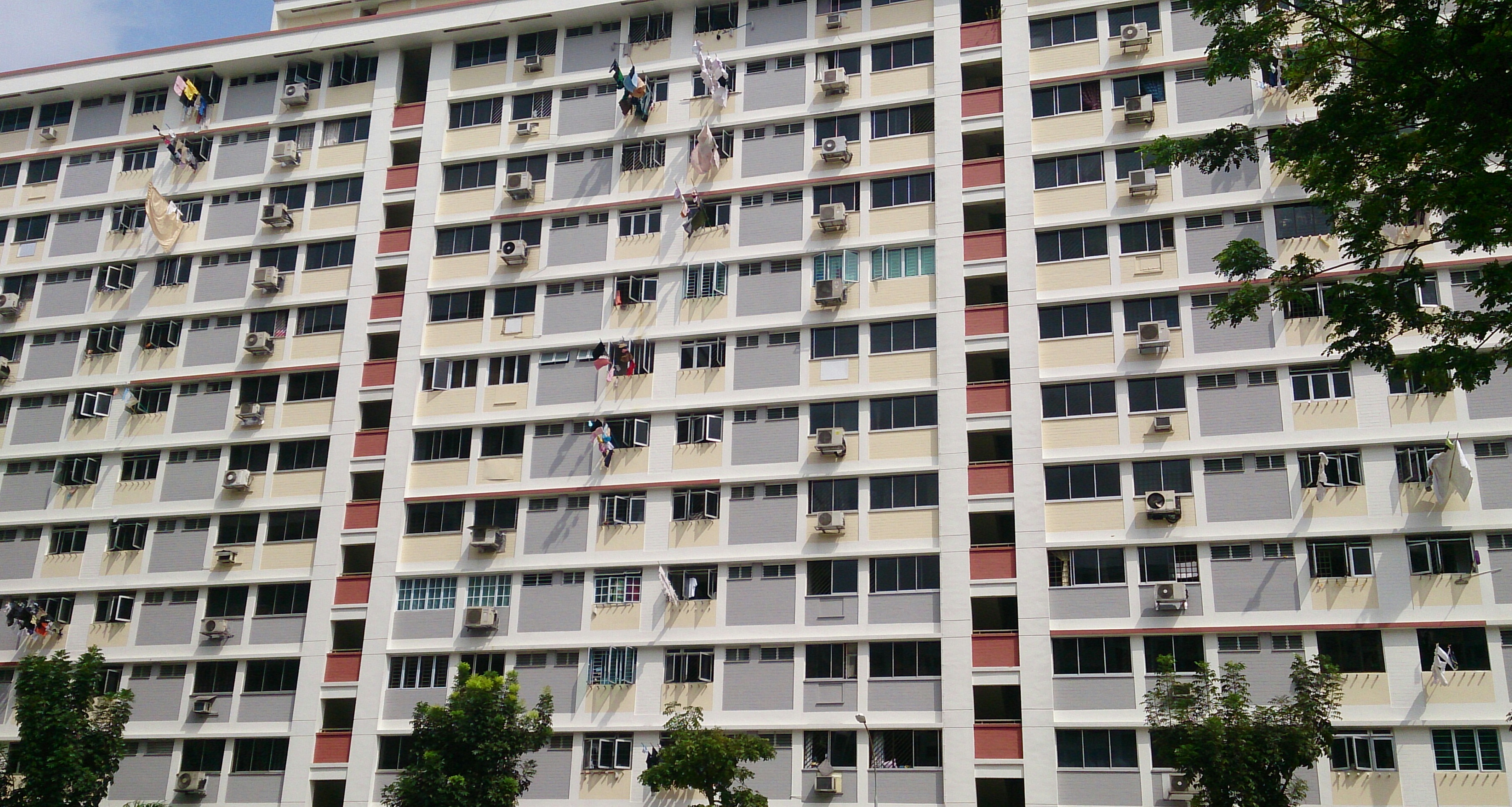
The distinctive form of Singapore's HDB blocks reflects decades of iterative design refinement within compact land constraints. Photo: Wikimedia Commons, CC license.
The Design Innovation Period: 1990–2010
The 1990s introduced several significant design innovations to HDB flats. The Home Improvement Programme (HIP) and estate renewal initiatives addressed aging infrastructure in older blocks while introducing contemporary amenities. New developments began incorporating varied building footprints, breaking from the uniform slab-block pattern.
Design Build and Sell Scheme (DBSS) units, introduced in 2005, allowed private developers to design and build HDB flats, introducing private-sector design sensibilities to public housing. Though the DBSS program was later discontinued, it influenced subsequent HDB design standards, particularly regarding interior layout flexibility and facade treatment.
Executive condominiums (ECs) emerged as a hybrid category, offering condominium-style amenities (swimming pools, gyms, function rooms) within a public housing pricing framework. After a specified period, ECs convert to private property status, creating a transitional housing category between HDB flats and fully private condominiums.
Build-To-Order and Contemporary Developments: 2010–Present
The Build-To-Order system, introduced in 2001 and refined over subsequent years, has become the primary mechanism for new HDB flat allocation. Under BTO, new developments are only constructed after sufficient applications are received, reducing the risk of unsold inventory and aligning supply more closely with demand.
Contemporary BTO developments incorporate features that earlier HDB generations lacked:
- Flexible layouts: Reduced use of internal load-bearing walls allows residents to reconfigure room boundaries during renovation. Some units offer column-free interior plans that can be partitioned according to household needs.
- Smart-home readiness: Pre-installed data points, USB charging outlets, and integration with national digital infrastructure reflect changing residential technology requirements.
- Universal design: Features such as wider corridors, grab bars in bathrooms, and barrier-free access accommodate aging residents, reflecting Singapore's demographic transition toward an older population.
- Sustainability features: Solar panel installations on rooftops, rainwater harvesting systems, and improved thermal insulation reduce environmental impact and utility costs.
Spatial Dimensions: How HDB Flat Sizes Have Changed
HDB flat sizes have evolved in response to both policy decisions and demographic changes. Current standard BTO configurations include:
- 2-Room Flexi: 36–46 sqm, designed for singles and elderly residents
- 3-Room: 65–68 sqm, targeting couples and small families
- 4-Room: 90–93 sqm, the most popular configuration for families
- 5-Room: 110–113 sqm, for larger households
- 3Gen (Three-Generation): 115–120 sqm, specifically designed for multi-generational families
The introduction of the 2-Room Flexi category in 2015 was particularly significant. It acknowledged the growing population of single residents and elderly Singaporeans who previously had limited access to new public housing. The flexible layout allows these smaller units to be configured as either a studio or one-bedroom arrangement.
Renovation Culture and Interior Adaptation
Singapore has developed one of the most active home renovation cultures in Asia, driven substantially by the HDB flat as a canvas for personal expression within standardized architectural shells. The renovation industry, estimated at several billion Singapore dollars annually, employs specialized interior designers who work within the specific constraints and opportunities of HDB dimensions.
Common renovation strategies for compact HDB units include:
- Removal of non-structural walls between living room and kitchen to create open-plan layouts
- Installation of platform beds with integrated storage, similar to the micro-apartment solutions discussed in our furniture analysis
- Custom carpentry for full-height storage walls that maximize vertical space utilization
- Glass partitions replacing solid walls to maintain visual openness while defining zones
- Retractable dining tables and fold-down desks for dual-purpose spaces
The HDB imposes specific renovation guidelines, including restrictions on structural modifications, limits on noise-generating work hours, and requirements for licensed contractors for certain work categories. These guidelines ensure building integrity while permitting substantial interior transformation.
Pinnacle@Duxton: A Case Study in Density
Pinnacle@Duxton, completed in 2009, represents perhaps the most ambitious HDB development to date. Seven 50-story towers connected by sky bridges at the 26th and 50th floors house 1,848 units on a 2.4-hectare site in the Tanjong Pagar district. The development achieves a plot ratio of approximately 9.3, among the highest residential densities in Singapore.
The sky bridges function as elevated parks and community spaces, providing 500-meter jogging tracks and garden areas at heights of approximately 100 and 200 meters above street level. This vertical community infrastructure addresses the challenge of providing outdoor recreational space in ultra-high-density residential environments.
Pinnacle@Duxton demonstrated that public housing could achieve architectural distinction while maintaining affordability. The project won the Building and Construction Authority's Design and Engineering Safety Award and has been studied internationally as a model for high-density public housing design.
The Intersection with Co-Living
The evolution of HDB design has created conditions that connect with the emerging co-living sector. Compact unit types like the 2-Room Flexi share design DNA with co-living studios, and the renovation culture has normalized transformer furniture and space-optimizing design strategies. The HDB's emphasis on communal facilities (void decks, common corridors, shared gardens) parallels co-living's investment in shared amenity spaces.
However, important distinctions remain. HDB flats are primarily ownership-based (through 99-year leases), while co-living is rental-focused. The demographic targets differ: HDB serves the broad residential population, while co-living skews toward mobile professionals and expatriates. And regulatory frameworks operate independently, with HDB policies set by the Board and co-living guidelines managed by the URA.
Singapore's HDB program has housed a nation within 733 square kilometers. The design lessons from six decades of this undertaking inform every aspect of how the city-state approaches compact residential living.